Showing posts with label greek mythology. Show all posts

Thursday, May 11, 2017

Prophecy of Solstice's End by Diantha Jones (Oracle of Delphi #3) -- Cover Reveal

Readers of this blog know that I love Diantha Jones' work, so I'm pleased to help reveal her new cover for Prophecy of Solstice's End. This new cover gives a taste of how fierce Chloe is as she comes into her own, but to get a better taste, go pick up the book! 

Prophecy of Solstice's End

Oracle of Delphi #3

By Diantha Jones 
BLURB:  Summer Solstice is here. Let the games begin. Nothing but lies (some of them her own) and deceit have brought Chloe to Olympus for the Solstice Olympic Games. As the Oracle and the special guest of the King of Myth, Chloe becomes immersed in a life of unfathomable luxury, taunting history, and overwhelming excitement. Though scheming and untrustworthy, the gods remain on their best behavior as the tension and anticipation builds around the outcome of the Quest of the Twelve Labors, the deadliest competition of the Games. All seems well on the celestial front...until athletes start turning up dead and a philosopher missing for months returns with a most terrifying story... But that’s not all. As Strafford confronts his troubled past and more is learned about the Great Unknown Prophecy, Chloe grows close to another, setting off a chain of events that will bring her face-to-face with a truth that will rock both of her worlds to their core. And it’ll all happen before Solstice’s end...
  Book Links: Amazon  | B&N | Goodreads
Author Bio: Diantha Jones loves writing fantasy books filled with adventure, romance, and magic. She's the author of the Oracle of Delphi series, the Mythos series, and the Djinn Order series (as A. Star). When she isn’t writing or working, she is reading or being hypnotized by Netflix. She is a serious night-owl and while everyone else is grinning in the warmth and sunlight, she’s hoping for gloominess and rain. Yeah, she’s weird like that.

Wednesday, October 29, 2014

Sometimes Greek myths are deep, and sometimes they're asparagus

I've mentioned my love of Who's Who in Greek and Roman Mythology before. Seriously, this was one of my favorite books when I was a kid and definitely when I was in the fifth grade, so I try not to judge too harshly when one of my sons wants to read things like Minecraft and Pokemon guides.

When I was in the fifth grade, I was drawn to the big ticket items in classical mythology, namely the Pantheon, the demigods and the major kings and queens. But even some of the "bit players" didn't escape my attention. Some of the stories, however short, make you feel like you've been punched in the gut.

To wit, Caenis:

Daughter of Elatus and Hippea, and the sister of Polyphemus and Ischys. Raped by Poseidon. (It's funny how often he, Apollo and Hermes show up in stories being rapists. The god you might expect to be the most likely to rape? Ares. However, so far I've only seen him in one story featuring a rape- and that was when he killed the rapist of his daughter Alcippe. The rapist? Halirrothius- son of Poseidon. Go figure.) To make up for the rape, Poseidon agreed to grant Caenis any wish. Her wish? To be turned into a man, henceforth known as Caeneus. Caeneus went on to father a child named Coronus, and died because he offended Zeus (always a lousy idea, but perhaps forgiven after what happened with Poseidon?). He was buried under pine trees, and then changed into a bird.

So much about power and sex in that story...no matter what Caeneus received from Poseidon, Caenis was dead.

But then, flipping through the pages, I come across this:

Melanippus, son of Theseus and Perigune (which baby mama was that again?). Father of Ioxus, ancestor of the Ioxids.

Ioxids?

Ioxus, son of Melanippus (another poor, motherless child). Ancestor of the Ioxids. And then...."The Ioxids held the asparagus to be sacred, a cult started by Perigune."


Asparagus Tip
What does this vegetable have to do with a family of serial killers? Let's ask Greek Mythology!
 Perigune!

Perigune, daughter of Sinis, mother of Melanippus by Theseus. Started the Asparagus cult.

*blinks* And who was Sinis?

Sinis, son of Damastes aka Procrustes and Sylea. Nicknamed Pitocamptes or "Pine Bender" because he would tie victims to the tops of pine trees and catapult them into the air. Theseus, in his tour of cleaning up the countryside, killed him the same way.

Damastes, nicknamed Procrustes or "The Stretcher", invited people into his house and made sure they fit the bed exactly. If too tall, he'd cut off their legs; if too short, he'd stretch them. Theseus, our hero, gave this guy the same treatment.

(And you people wonder why I don't need to watch horror movies.)

Er, who was Sylea, the grandmother of the Asparagus-loving Perigune? (And was she crazy too?)

Sylea, daughter of Corinthus, mother of Sinis...

Corinthus, King of Corinth (wow, psycho outlaw is a big step down for Sylea then!). Son of Marathon, Father of Sylea. Because he didn't have any sons, his rule of Corinth passed to Medea and Jason. (We can feel bad for poor Sylea- until we contemplate that her husband and son were sadistic serial killers. And...huh. Medea was Theseus' stepmother for a little while.)

Well, okay, let's climb out of the Greek version of hillbilly psychos...who was Marathon?

Marathon, son of Epopeus and Ephyraea, father of Corinthus.

Epopeus, king of Asopia...evidently without parents worth noting. (Same for his wife Ephyraea.)
Which leads me to wonder: is Asopia on the path that Theseus used to get to Athens? And more importantly, do they grow asparagus there? And, oh yeah, is this story of serial killers and the brute who killed them better or worse than the one about the girl who was raped by a god?

These and other light thoughts brought to us by the Ancient Greeks. Good morning!

Friday, February 21, 2014

Lover, Divine by A. Star (The Oracle of Delphi Series)


Lucky me- I got an advanced review copy of this book. (The fact that I stalked the author for a couple of months before might have been helpful.) As readers of this blog know, I'm a huge fan of The Oracle of Delphi Series, and I loved the other short story put out that gave us some insight into Strafford aka Solar aka the Sun Prince, the protector and beloved of Chloe Clever, the new Pythia.

Lover, Divine tells the story of how his Influential mother Siobhan and his Olympian father came together. It's immediately apparent that Strafford's stubbornness is derived as much from his mother as it is from his father. Even when she discovers the truth about her suitor's origins- there are immortals and then there are immortals- Siobhan is determined to maintain her dignity and free will, "destiny" and "prophecy" be damned. So what's the key to get her to accept a divine lover?

Um, it's got a little something to do with why we are DEFINITELY out of YA territory here (in case the cover didn't already give that away). In other words, this is erotic and explicit (and really well done), so if that's a problem for you, you might want to skip this installment...

But maybe you shouldn't. We start to understand the inner workings of the Influential world, and we know that's going to affect not just Strafford but a few other pivotal characters in Chloe's saga. Perhaps even more importantly, we get a clue about yet another player in the impending Olympian War. (Hmm...didn't see that one coming!)

This is a very engrossing read. I highly recommend it for fans of The Oracle of Delphi series (particularly those who like a little spice!).

Monday, January 6, 2014

Giveaway: Aphrodite: Goddess of Love by George O'Connor

If you've ever read this blog, you know that I love George O'Connor's take on the Greek myths. (I also love him for turning me onto one of my favorite books, The Marriage of Cadmus and Harmony.) When his new releases come out, I imagine I'm just like one of those people who wait in line for the newest release of World of Warcraft or Grand Theft Auto.

I missed the actual date that Aphrodite dropped, but this Saturday I bravely trekked into the freezing- and I mean freezing- weather to pick up my copy at Barnes and Noble...only they didn't have it. I called Newbury Comics; they didn't have it. When I got home I checked the Brookline Booksmith site- they didn't have it either. Argh! In desperation, I placed an order from Amazon.


So imagine my consternation when I discovered yesterday that Brookline Booksmith did indeed have it. I am loathe to part with any more cash than I need to, but as I held the copy in my hands, I thought there could be worse things than having two copies of George's work. And then it hit me: I was going to give one away!

Below you'll find your standard Rafflecopter giveaway. I'm asking for three things: 1) sign up for my newsletter (you know you wanted to anyway), 2) Like George's Facebook page and 3) Follow him on Twitter. That's it. If you want to tweet about or otherwise share it, awesome, but I'm not going to make you.

In case it wasn't already clear, this is entirely my idea- George had nothing to do with it. In fact, I imagine he's sitting in his Brooklyn apartment, cringing in embarrassment over the whole thing. But that's what fans are for ;-)

I'm running this until Friday, January 10th, midnight, and as soon as I can on Friday I'll announce the lucky winner.

What are you waiting for? Enter now!

a Rafflecopter giveaway

Sunday, January 5, 2014

Aphrodite: Goddess of Love (Olympians) by George O'Connor

Great art? Naturally. Humorous but insightful character development? Of course. But that's not what makes George O'Connor my favorite go-to for mythology. Here as in other volumes, he is able to cut to the heart of the conflicting myths and find the essence that unifies them; in doing so, he makes the origin of an enigmatic figure clear.

Is Aphrodite the daughter of Zeus or born of the essence of the castrated Uranus? (And boy, if you didn't get that he was castrated before, the graphics are going to make that very clear.) And how is it that Eros was born from both Chaos *and* Aphrodite? Sit back and smile as George explains it all.
Aphrodite in classical myth is easily the least sympathetic of all the Olympians as she and her mischievous son/male counterpart Eros ruthlessly inspire unrequited love and destroy marriages. In a heated exchange with Hera, Aphrodite succinctly sums up why she's probably the deity we want to side with after all. Three decades of closely reading mythology, and I had to smile as I finally saw an essential cultural tension played out not by Apollo and Dionysus but Hera and Aphrodite. Read their brief exchange, then go back and re-read the rest of the graphic novel; suddenly Aphrodite is much more sympathetic.


This is not the most romantic of the series- that honor goes to Hades- but we do get to see more of the continuing love affair that has been playing out since the first volume. Zeus, the most sensitive to Eros, at the end of the day has one true love: his power. However alluring Aphrodite- or Thetis- may be, he will do nothing to compromise his beloved. When you see Zeus act as wedding planner, you've got to know that something else is up.

An exciting midway point for a fantastic series. Highly recommended for fans of Greek mythology.

Monday, December 2, 2013

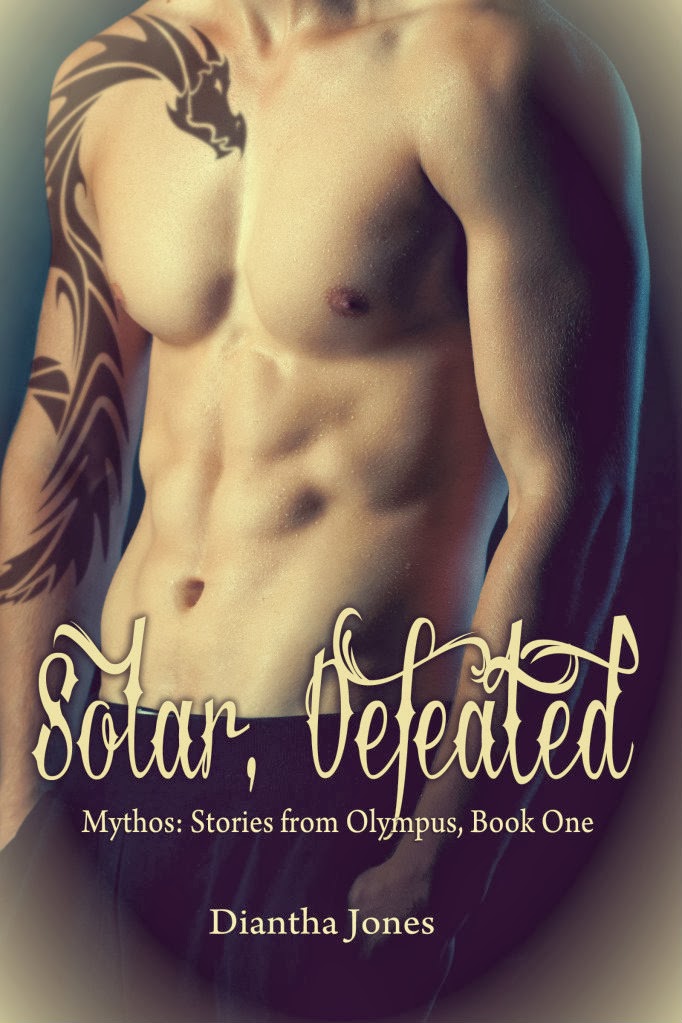
Hero, Cursed (Mythos: Stories from Olympus #2/Oracle of Delphi #3.5) by Diantha Jones - Cover Reveal and Giveaway


Before he knew the Oracle...
Before he knew the Quad...
Before the Great Unknown threatened his world...
He was a hero, cursed forever.


Cover Designed by: Colin F. Barnes
Publication Date: March 18, 2014
Genre: YA Mythology
Series: Mythos: Stories from Olympus #2/Oracle of Delphi #3.5


*WARNING* To be read after Prophecy of Solstice's End (Oracle of Delphi #3)
Contains MAJOR spoilers!

Shunned by a family that doesn't understand him, demigod Lenka Tahile aka "Swindle" is a complete loner and he likes it that way. Then he meets the hero, Ace Remedy, the brother of an infamous demigod Prince, and his life goes from bad to worse. Ace is loud, rude, and disruptive to his peaceful existence in every way. He's also hilarious and daring, and Swindle ends up finding a friend just when he thought he'd never have another.

But little does he know, becoming friends with Ace was all part of the Fates' plan. Now his past is slowly coming back to haunt him and there's nothing he can do to stop it. Nothing but try not to bring to light the lost love, the failed hopes, and the cursed existence that he would kill to keep in the dark.


Five Facts about Hero, Cursed

1. Lenka Tahile is a South African name. The MC was born in South Africa.

2. "Swindle" is Lenka's celestial name. He is a son of Hermes. Figure it out.

3. The hawk on the cover is not a tattoo. His name is Bill and he's Swindle's Fauna Morph, an animal that morphs into a weapon on command.

4. Though it isn't showcased on the cover, Swindle has extremely curly hair. Out of control, I tell you.

5. Just like Solar, Defeated, this novella switches back and forth between the present and the past, and reveals what life was like for Swindle before the Oracle of Delphi came along.


Mythos: Stories from Olympus #1

Amazon  |  Barnes&Noble  |  Goodreads

Giveaway!


Diantha Jones is pleased to offer a free e-copy of the first book in this series, Prophecy of The Most Beautiful. (You can read my review to see why I think you should take her up on that!)

Leave your name, your preferred e-format and the best way to contact you in the comments below to enter. Winner by selected at random on December 8th.


Diantha Jones was born the day thousands of turkeys sacrificed their lives to fill millions of American bellies on November 22 which also happened to be Thanksgiving Day (Her mother says she owes her a turkey). She is a Journalism graduate who wants to be a career novelist (of books, not Facebook posts). When not writing or working, she is reading on her Nook, being hypnotized by Netflix or on a mission to procure french fries.

The Oracle of Delphi fantasy series is her first series. She is also the author of Mythos: Stories from Olympus, a companion series, and there is another fantasy series in the works. She also writes (new) adult fantasy/paranormal romance under the name A. Star. Invasion (An Alien Romance) is her first title released under this pen name. Future releases under A. Star include, Mythos: Gods and Lovers series, the Love & Steampunk series, the Purr, Inc. stories, and more.

Website  |  Twitter  |  Facebook  |  Goodreads  |  Amazon  |  Pinterest  |  DJ's Book Corner


Monday, October 21, 2013

Prophecy of the Solstice's End (Oracle of Delphi #3) by Diantha Jones (@dianthajones)

Disclaimer: I received a review copy in exchange for an honest review.

Another disclaimer: this is a long book. My copy came in at 408 pages, and I might have waited a few extra days to get into it because of that.

No worries: I more than made up for it when I found myself unable to put it down and staying up way past my bedtime to read just a little bit more. I read this on my laptop- on the train. When I say I couldn't put it down, I meant it.

Why? Because things come to a head when Chloe and her team answer Zeus' summons to attend the Olympic Games- the games her true love Strafford aka Solar aka The Sun Prince just happens to be competing in. Did you have some huge questions after the first two installments? Jones delivers on a lot of the answers, particularly those concerning Hermes' son Swindle, the all-seeing Thetans, that devilishly charming son of Zeus Torrent and- oh yeah- Chloe's father. (You'll want to say "apples don't fall far from trees"- but then you're going to start wondering which tree we're concerned with.)


Wouldn't it be nice if Chloe and her demigod friends could work out their family dramas in relative peace? Sadly, no. They still have the little matter of constellations falling out of the sky- and wait until you see the ones that fall out in this book- and Apollo and Zeus circling each other to see which one is going to throw down the gauntlet first. We learned in the last book that Apollo has help; don't worry- so does Zeus. No surprise that there are several attempted murders. What's more surprising is that not all of them are successful...yet another mystery for us to solve.

In the last book we saw Chloe come to accept her role as the Oracle; in this book we get to see her exercise her power, and it's awesome. It's about damn time someone reminded these obnoxious gods that they're not in charge, and she is just Oracle to do it. But maybe- just maybe- not all of the gods are as terrible as they seem.

Highly recommended for YA and mythology fans. Now if only Jones would hurry up and get Book Four out, we'd be all set!

Sunday, October 6, 2013

Beauty's Daughter: The Story of Hermione and Helen of Troy by Carolyn Meyer

I've been a hardcore mythology fan for over three decades, and Hermione has always fascinated me. The daughter of Helen of Troy and Menelaus who first married the son of Achilles and then married Orestes, the cursed and then redeemed son of Agamemnon and Clytemnaestra, in many ways her story represents the continuing consequences of the actions Helen set in motion. Precious little has been written about her, so I was very excited to see what this novel would offer.

Unfortunately I was disappointed almost immediately. Helen is the stereotypical, vilified beautiful woman: shallow, vain and distant, to the point where she has no maternal instinct toward her less beautiful daughter. While we can understand how a child would perceive the mother who later abandoned her that way, I was offended by the way Helen laughed off her abduction by Theseus when she was a child. In this retelling, it was a harmless lark which reinforced that she was the most desirable woman in the world. Other authors have gone into detail about what happened to Helen while she was with Theseus, and it wasn't described as something someone would laugh about. It was chilling that a rape victim would be portrayed as, essentially, a narcissist.

I also took exception to the portrayal of Clytemnaestra, who comes off even before Agamemnon's treacherous attempts to murder their daughter as an unpleasant shrew- even though it's known to the reader that Agamemnon murdered her first husband. (In the original version of the story, Agamemnon also murdered her infant son.) Clytemnaestra is one of the most complicated characters in Greek mythology and because she's so important to this story deserves a closer examination.


Hermione is sympathetic for most of the book, and we admire throughout the story her assertiveness and resourcefulness. But there are enough places where she comes across as unreasonably selfish and frankly childish that she loses a little bit of rooting value. Also, knowing the myth, it was off-putting that the author only included elements that made Hermione a heroine and excluded those that didn't.

I also wasn't sure what kind of book I was reading. The tone of the book was inconsistent; while at times it felt like a Middle Grade book, it would jump at times to a very mature Young Adult, if not New Adult. (There is no explicit content, but there are clear indications of a brutal rape.) Also, as the author notes, this is a romance, in this case between Hermione and Orestes. However, the conclusion of the romance feels both forced and rushed, and after having spent 150 pages waiting for them to be reunited, the Happily Ever After is unsatisfying.

Despite these problems, I'd still recommend this for mythology fans- but only after consulting other sources of the story.

Wednesday, October 2, 2013

Prophecy of the Setting Sunrise (Oracle of Delphi #2)

Young Chloe Clever, aka Pythia, aka the Oracle of Delphi, is starting to get a little more confident in her new job as the keeper of the Great Unknown Prophecy. Which is good, because her job gets even tougher in this book: Apollo may be a ruthless SOB, but she's about to attract the attention of beings far more frightening. I won't give it away, but let's just say it's a good thing Chloe finds she can suddenly read a very old and otherwise forgotten language, however much it might dismay her demigod guardians.

If only Chloe could focus on forces of nature striving to take over- and occasionally rescue- the world. Unfortunately, the gods decided to bring the conflict home to her- literally. And while Chloe may think that was all about her, she quickly understands that the victim plays a special role- and more special than anyone could have imagined before. Oh right, someone did figure it out in the last book, so why is Chloe only finding out now? Let's just say it has a little something to do with the bonds between siblings- and the lack thereof between parents and children.


The questions remain. When is her beloved Strafford aka Solar aka The Sun Prince going to explain his dishonor to Chloe? And speaking of parents, why is Chloe's mother taking everything so calmly? And where is Chloe's father, why did he leave and what does he know? As one of the characters says, it's all about choices. Can even the Oracle of Delphi make the right ones when all this is going on?

As one of the characters says, it's all about choices. Can even the Oracle of Delphi make the right ones when all this is going on? Maybe, but not without a terrible sacrifice.

Once again, Jones made the myth-geek in me smile. Not to give anything else away, but let's just say that if Apollo is plotting a coup, he picked the perfect god to team up with. Apollo's light needs to be tempered with a little darkness, but darkness comes in different shades.

Looking forward to the next installment, and highly recommended once again for fans of mythology and young adult.

Friday, July 26, 2013

An interview with Diantha Jones, author of Prophecy of The Most Beautiful

As readers of this blog know, I'm a sucker for Greek mythology. However, I'm a little more discriminating about mythology fan-fiction. However, I thoroughly enjoyed Prophecy of The Most Beautiful by Diantha Jones. Below is our chat about Fate, mythology and unfinished business.


How did you develop an interest in mythology?

I'm not quite sure how it developed exactly but I've been into Greek myth for years and years. I'm sort of a historical nut and the ancient Greeks are really interesting so I'm sure that had something to do with it.

Of all of the aspects of the mythological world, what made you decide to focus on the Oracle?

The importance of the Oracle to the ancient world has always been so downplayed that I felt it was my duty (in a sense) to push her out into the spotlight. But in a new, fun, modern way!

Chloe appears to be disturbed in the human world, but in the Myth world she is, in a way, "the one" the gods have been waiting for. Is that every teenager's fantasy?

To be a hero and save the world? Deep down, I think every person alive dreams of being someone's hero. But for teenagers I think the feeling is magnified because of how awkward we all feel as teens and unsure we are of what the future holds for us. But I think being told that another world exists and that it's in danger of crumbling unless you can save it, is the unspoken fantasy of every young person in the universe.

You've created an interesting dynamic in the Myth world: there are unclaimed children who are treated badly, claimed children who have some privileges but are still seen as, essentially, dispensable by their immortal parent, and then (not to give too much away), royal children. When you were creating this world, what moved you to put that in?

Even though this is a fantasy world, I wanted there to be some semblance of reality in Myth. I did this by creating a sort of hierarchy among the demigods. There are the undeclared orphs, the declared heroes, and the Royals. Everyone is not created equal in Myth, not even those born of the gods.

Not to give too much away, but you went with two very old stories as a jumping off point for your book (one of which is arguably older than Greek mythology itself). What inspired you about this particular, er, love triangle?

One of the best things about Greek myth is the relationships they (the gods and such) all had with one another. They supposedly ruled the universe together, yet at the same time, despised one another. So it's always interesting to read about how these rivalries played out in mythology. This particular "love triangle" grabbed my interest because one of the players really had no business being a part of it and it intrigued me about how they came to be so. I don't delve too much into the how in Prophecy of the Most Beautiful, but I more so concentrate on the results of it and add my own little spin on the events. I think it worked well for this book and the direction the series is going.

The myth you went with as the basis of the series really excited me. Again, I won't give too much away, but I think every myth fan who ever read the stories closely has been irritated by this bit of "unfinished business". Are you trying to pick up where the ancients left off?

Yes! You may be the first person to realize that (or at least, the first to say so). I'm adding to the myths, not retelling them. "What happened next?" is a question I always asked. Did it all just end there...with the Olympians? I would like to think it didn't and that the ancients just didn't get around to writing it all down for us.


One of the characters speaks a great line in the book when describing the relationship between Fate and free will: "Their destiny is transferred into their subconscious where it can execute itself." Is that what you believe about Fate?

In reality, I'm a religious woman, so destiny (fate) is not in my hands or in the hands of anyone but God.

People have been using mythological references in their work since, well, Homer (if not before). But when I was growing up, it wasn't something anyone but the nerdiest kids (myself included!) were interested in. And for the most part we weren't getting cool fan fiction- we had to seek out Bulfinch and Hamilton and stuff that Victorians and academics liked. Why do you think there's been this explosion of interest in those stories and their offshoots in the last decade?

I see it like this. Everything is a cycle. Fashion, television, movies, and books. What was lame before may not be so lame now, but it will be again some day. And then it will just circle back around and the next generation will make it cool again. Vampires are not as hot as they were a few years back, but their time will come around again as well. Mythology is hot now, but it won't be forever. So yeah, it's just all a cycle to me.

What's next for Chloe in Prophecy of Solstice's End?

More scheming, plotting and downright backstabbing than ever before. The gods are on their best (worst) behavior and their secrets and deceptions hidden around every corner. Chloe's going to have to learn who she can trust...and who she's going to have to let go forever.

What other projects do you have in the pipeline? And do you see yourself staying in Myth (literally or figuratively)?

Lol. Well, there are two more novels (Prophecy of the Betrayed Heir and Prophecy of the Eternal Empire) to be released in the series, plus two more novellas. Then I have my New Adult fantasy romance series, Love & Steampunk, in the works right now. Plus I'm in negotiations with a fellow author to work on an erotic anthology together. So...FUN. That's what's coming down the pipeline.

Biography

Diantha Jones was born the day thousands of turkeys sacrificed their lives to fill millions of American bellies on November 22 which also happened to be Thanksgiving Day (Her mother says she owes her a turkey). She is a Journalism graduate who wants to be a career novelist (of books, not Facebook posts). When not writing or working, she is reading on her Nook, being hypnotized by Netflix or on a mission to procure french fries. 

The Oracle of Delphi fantasy series is her first series. She is also the author of Mythos: Stories from Olympus, a companion series, and there is another fantasy series in the works. She also writes (new) adult fantasy/paranormal romance under the name A. Star. Invasion (An Alien Romance) is her first title released under this pen name. Future releases under A. Star include, the Love & Steampunk series, the Purr, Inc. stories, and more.

Where to Find Diantha Jones

Website  |  Twitter  |  Facebook  |  Goodreads  |  Amazon  |  Pinterest  |  DJ's Book Corner

Email Diantha Jones at: theauthor (at) diantha-jones (dot) com

Prophecy of the Most Beautiful by Diantha Jones (Oracle of Delphi #1)

Chloe Clever has had it rough: her father left her family a few years ago, she’s plagued with hallucinations of the scariest kind and she’s her high school’s resident freak.

By the second chapter we know why: Chloe is the Oracle of Delphi, and the voices she hears and visions she sees are real. She’s saved in the nick of time from certain death at the hands of an evil Ker by the children of... Apollo. Turns out the god of prophecy has some very good reasons to want to protect the Oracle, but Chloe learns very quickly that the gods don’t do anything for free.

The first people to warn her about the gods? Their demigod children, who may have been blessed with some of their immortal parent’s power, but are all varying degrees of dispensable. Even Strafford Law, the most powerful of Apollo’s children, is ultimately just a tool of his father’s. Chloe, however, quickly sees him very differently.

Chloe’s task is to figure out The Prophecy of the Most Beautiful, and even The Knowledge bestowed (or forced?) upon her by Apollo isn’t enough on its own. In fairness, though, having to fight off attacks and encountering people literally falling from the sky is a huge distraction. But even before she does solve it, it’s clear that Olympus has bigger issues simmering, and Apollo, Strafford and Chloe are destined to play a huge part in what’s going down. So, evidently, might her family, but that’s a story for the next book.

As a longtime mythology fangirl, I love that Jones begins to tie up some “unfinished business” the original stories left us dangling with. Not to give anything away, but Roberto Calasso would definitely approve of the way she’s doing it. Also, Jones drops hints several times that Chloe’s previous life may not have been everything she thought it was, but my jaw still dropped when we realized just how different it really was. I cannot wait to see how the twist with her family plays out. Finally, I enjoyed the character Strafford; I’m very curious now to uncover why he needs to redeem himself- and how he’s going to do it.

Recommended for mythology fans.


Wednesday, April 3, 2013

Poseidon: Earth Shaker by George O'Connor

I had this as soon as my copy came in to my favorite indie bookstore.  Sadly, I wasn't the first one in the house to read it; I lost the game of Keep Away I had to play with my sons once it came home.

It is a testament to George O'Connor's talent that I was moved at all by his rendering of the story of Poseidon, god of the seas, as much as I was.  Poseidon has always come off as haughty, moody and vengeful.  I don't think I'm the only one that has found even Hades more sympathetic.

O'Connor's Poseidon remains moody and vengeful, but here he also gets the benefit, as it were, of tragedy.  Poseidon senses that he's been cheated and (naturally) suspects Zeus.  But it isn't until the end of the book that Poseidon understands what he really lost.  A sibling is involved, but not the one he was worried about.

Poseidon, as he broods, turns to his admittedly "monstrous" offspring, particularly the cylops Polyphemos and Theseus. Through Polyphemos we get our first glimpse at the Trojan War and some of Odysseus' story. While I don't condone cylopes eating people, it's hard not to shake your head at Odysseus just a little bit.


The story of Theseus is even more complicated, starting with his birth.  Who was his father- Aegeus of Athens or Poseidon the Olympian?  O'Connor doesn't come right out and say it, but Theseus' ruthlessness- and the way his actions serve Poseidon's ends- should speak for themselves.  Any extra sympathy you may have for Poseidon can easily be debited from Theseus- O'Connor doesn't pull any punches with that, ahem, hero.

But Poseidon is more than just his progeny.  He spends much of his time brooding over his thwarted ambitions.  Being god of 7/8ths of the earth isn't enough- what's an Olympian got to do in order to get a city?    The book ends as Poseidon tries to assuage his wounded pride- then comes full circle to realize what he's really haunted by.

O'Connor the storyteller knows just how much to say for maximum effect, both to carry the story and give insight into the characters.  It doesn't take him long to convey Odysseus' (and Athena's) arrogance, Theseus' ruthlessness or Ariadne's emotional conflict.  O'Connor the illustrator is as vivid as ever but in this volume unusually jolting (not to give anything way, but the Polyphemos story is never gently rendered).  His action sequences give a sense of the quick and desperate nature of the life and death combat he describes.  The overall effect speaks to the brutal nature of the classical myths about Poseidon, the most unpredictable of all of the Olympians.

Do I need to tell you that if you're a Greek mythology fan you need to buy this now?

Thursday, February 9, 2012

Review for Hades: Lord of the Dead by George O'Connor

There are a couple of myths I can't stop thinking about, and one of them is the myth of Persephone, daughter of the harvest goddess Demeter and wife of Hades, lord of the realm of the dead.  She is everything from a symbol of the transition from childhood to adulthood to an explanation for why the seasons change (well, at least in temperate climates).  In more obscure (older?) stories, she also plays an important role in the story of Dionysus, which makes sense in light of the cycle of life/death/rebirth that both divinities embody... but that might be another story for another day.


Every version of the story that I have ever read features a young girl who is completely without agency.  For the most part, Demeter doesn't have any either.  She reacts in rage, but ultimately she must comply with the will of her brothers Zeus and Hades (and in some versions even Poseidon).  This myth embodies the tension between men and women in the ancient civilization and to some extent also our own.

If anyone else has ever been bothered by that, you're going to love George O'Connor's version.

Persephone is kidnapped by Hades, Demeter grieves and the earth turns barren, Helios tells her about the collusion between Zeus and Hades, Persephone comes back but only for half of the year.  Yada yada yada- every major plot point you remember is there.  It's what O'Connor fills around them that makes this delicious.

Ask yourself: how many young girls want to be so tightly held by their mothers?  What kind of a goddess is willing to destroy mankind in vengeance for the loss of her daughter?  And if someone were offered a throne, how many people would willingly say no?  Sunlight is warmer than the underworld, but sometimes warmth is stifling.

It's not all Hades and Persephone's love affair.  As O'Connor hinted a few months ago, we also get to see why Tantalus is related to the word "tantalize".  Importantly, O'Connor isn't just throwing that in here because we're talking about Hades and Tartarus.  In most versions of the myth, Demeter's behavior is, um, anti-social because she's distracted by her search for her daughter.  I loved the way O'Connor followed the strings of those two stories about starvation, human sacrifice and cannibalism.  In this version, Tantalus is an indirect contributor to the resolution of the story, and it makes sense.

At the risk of being presumptuous, I'm going to disagree with O'Connor's characterization of Hades as "emo".  For me, that conjures up images of a darkly dressed Hamlet moping through his palace, unsure of what to do next.  Hades is darkly dressed, and we could argue he mopes.  But Hades, too, has agency, and here it is as meaningful as Persephone's.  And what good is a myth if it doesn't provide us with meaning?

Highly recommended.