Tuesday, November 20, 2012

Breakout Nations: In Pursuit of the Next Economic Miracles by Ruchir Sharma

Breakout Nations is ostensibly an investment guide, but it’s really a snapshot of the world economy, particularly the emerging markets and those that are on the verge of “breaking out” or achieving the next level of income.  (Although the term “emerging market” is used in different ways in different places, for the purposes of this book it refers to nations in which the average annual per capita income is less than $25,000.)

You cannot talk about this class of nations- or the global economy itself- without talking about China.  China itself is an emerging nation and has driven the growth of many of the others, particularly those that are dependent on commodity exports.  While the political posturing around China tends to veer to extremes- “China is eating our lunch!” or “China is about to implode!”- Sharma takes, appropriately, the middle path.  Much of the low-hanging fruit has been grabbed in China, and much of that is dependent on demographics: while China was able to add about 90 million workers between the ages of 35 and 54 to the workforce in the last decade, in this decade they will add closer to 5 million such workers.  The smaller workforce translates into higher wages and thus higher prices, and that will almost undoubtedly lead to a shrinking of demand for their manufactured goods.  In other words, growth rates of 8 percent or more are most likely a thing of the past.  However, Sharma is more bullish on China (at least compared to the bears) in part because while many of the easy gains have been realized, there is still a need to modernize its manufacturing infrastructure, and those are the kinds of investments the Chinese governments have been keen on.  China will most probably cool, but reducing to 6 or 7 percent annual growth is a less dire scenario than reducing to 4.

China’s economy has been driven by manufacturing and it’s increasing output has been dependent on commodities from other countries.  While there were fortunes to be made from commodities, the rule seems to hold that an economy highly dependent on them is more likely to overheat and then eventually crash than one that isn’t.  Russia and Brazil are good examples of a such; they are living large right now but don’t have a cushion to fall back on when demand inevitably recedes.  Of all of the commodity economies Sharma profiles, only Indonesia seems to know how to work the dynamics to its favor, possibly because they were burned by the cycle in The Fifties.

Manufacturing has been considered the smart way to grow an economy from one level to another, but it’s far from a silver bullet.  While Taiwan grew significantly because of its manufacturing output, its weakness is that it never made the transition from a destination for other nation’s factories to a nation that had its own industries.  Against the prevailing wisdom at the time, South Korea did make that transition, fostering corporations that built innovative products (and subsuming those that weren’t competitive in the market).  And while many of the largest South Korean companies are family-owned, they tend to be professionally managed.  Of all of the countries profiled in the book, South Korea is the one Sharma seems to be betting will be the breakout.


Perhaps surprisingly, Sharma is a little more bullish on Europe than most economists although he, like many others, argues that the inherent weakness of a shared currency like the euro is that it leaves individual nations unable to adjust when circumstances demand it.  However, while many nations in Europe are going through a downturn, Poland and the Czech Republic are quiet standouts, in large part because they have paid attention to the fundamentals of a good economy, including putting money away to make strategic public investments.  

One has to wonder how the leaders of the European Union feel about their treatment of Turkey’s entrance application several years ago.  Certainly, the Turkish are probably relieved that they were denied.  The energy released when the Turks lifted their ban on open displays of religious culture corresponded with a vigorous economic revival.  While certainly based on manufacturing, it is more dependent on domestic demand than other similar economies and has gone hand in hand with domestic investment in infrastructure (and education).  However, a potential weakness is that its domestic savings is relatively low- 20 percent compared with 50 percent in China.  Another potential weakness is that Prime Minister Recep Erdogan, while a cautious economic steward, has been in power for a decade and has indicated that he would like to remain so, albeit in a different role.  It remains to be seen whether he will be more like a Putin or Wen Jiabao.  Of course, as Sharma notes, the leader who can effectively manage a country’s finances can usually get away with almost anything politically.

If investments are bets, Sharma is hedging on India.  While the large population and cultural dynamism are now seen as strengths, India’s political system, rightly charged with corruption and cronyism, is what is holding it back.  While any student of Indian history is reluctant to give Churchill credit for any insights, he did have a point when he noted that “India” was as desriptive of a political or economic system as “Europe”.  Certainly we are seeing that now as modern Indians seem more engaged in local than national politics.  Also, India, like many of the other countries profiled in the book, has been guilty of believing its own public relations campaign and presuming that it will be the next China.  The extent to which the Indian government can implement policies to make it so- even if it’s at the expense of its traditional clients- will determine the extent to which they can make their advertising a reality.

If there is a problem that the global economy suffers from as a whole, it is an unwillingness to tolerate the kinds of recessions that punctuated our overall trend of growth for the last 150 years.  Indeed, the emerging market miracles are a direct result of the stimulus the United States implemented to smooth out the dotcom bust of 2000 and 2001.  The low interest rates did exactly as intended and increased money available for investment.  Unforeseen, however, was the extent to which that money would flow into foreign markets, which led to the booms in these nations.  Easy money was key to growth for some, but intelligent policies are necessary if those gains are going to be maintained or built upon.  Those well-positioned to do that are the ones who will break out.

While Sharma backed up almost all of his assertions with data and statistics, I was surprised that this didn’t have better footnotes.  In spite of the copious statistics, this was a compelling if not “easy” read.  Recommended for those who have been following current affairs.

Tuesday, November 13, 2012

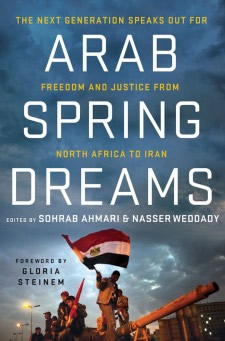
Arab Spring Dreams, edited by Nasser Weddady and Sohrab Ahmari


“If you do not confront the truth, you cannot be a good writer.  And the truth is not simply facts: truth is what lies behind the facts.  Hold up a mirror to your society and yourself... Every fresh Bin Laden tape is headline news, but the voices of the young essay writers must also be heard.  The pursuit of happiness is not a right only for people in the West.  People in the Muslim world need to reclaim their rights, and young Americans need to stand in solidarity with this civil rights struggle.”  (p. 100, Azar Nasfi, author of Reading Lolita in Tehran)
Don’t let the name fool you- the essays in Arab Spring Dreams were written before the Arab Spring began.  However, the young writers of these essays are the immediate precursors of the Arab Spring Revolutionaries, and by the end of the book you’re going to ask yourself not how the uprisings began in the first place but why they didn’t begin much sooner- and in more places.

All of the essays were written by people in the Middle East and North Africa under the age of 30 and were submitted for the “Dream Deferred Essay Contest on Civil Rights in the Middle East”, sponsored by the American Islamic Congress (AIC).  The contest is the brainchild of Syrian dissident Ammar Abdulhamid, who lamented that young people were given incentives to radicalize for religious extremists, but that young liberals in that region didn’t have the same opportunities to organize.  This contest is in part a means to open those avenues.

What unites all of the essays is the recognition of the writers that the world they inhabit is cheating them of something that should be theirs.  Some of the essays touch on the larger problems: Female Genital Mutilation, Homophobia and institutionalized Sexism.  But the ones that I found particularly touching were about the small, daily grievances.  Those of us who can drive may think it’s annoying but quaint that women in Saudi Arabia aren’t allowed to- until we are told that this often means that boys of 11 or 12 become chauffeurs for the women in their family.  For those of us who aren’t religious, the differences between Sunni and Shia observance may seem at best academic- until we read how those differences becomes the bases for childhood taunts and adult arrests.  And while we may say that the cultural prohibition against marrying before you’ve achieved financial independence has reasonable economic roots, we might rethink that when we hear about a young couple being threatened with an arrest and then blackmailed into a bribe because they were caught cuddling under a tree.


Some of the essays imagine a future in which someone breaks the status quo- whether of a sexual norm or in defiance of the current political regime- and does so openly.  The most hopeful essay of the bunch, perhaps, imagines Egypt in 2013, after a revolution has overthrown the oppressive government.  This was written before 2011, and while the narrator is grateful for change- particularly the freedoms of the press and the marketplace- he notes the work that continues to need to be done.  The hopeful part is that the narrator is willing to do it, however difficult it is.

The essays aren’t clever, and most of them are written simply.  It would be impossible to read one and not immediately understand the point the author is trying to make.  Any one of them should put to rest the myth that people in this region- or in the Muslim religion- are somehow incapable of appreciating or not ready for liberal democracy.  The editors discuss that myth and its origins at length at the end of the book.  Anyone who has ever argued that an essential, “authentic”, monolithic Islamic character will doom freedom in the region to failure should be given a copy of this book.  They also point out that our own civil rights struggles were met with “outsider” objections that efforts in the Middle East and North Africa are meeting with now.  Both complaints are just as hollow.

The book is not bitter, and at the end the reader is offered both practical solutions to help and a chance to dream.  Read up on the civil rights movements in the region; enter the American half of the Dream Deferred Essay Contest and follow relevant organizations and individuals on social media.  Do you want to do more?  Start a blog, as Jane Novak did for Yemen.  Initiate a dictatorship study so the world won’t be caught by surprise at the next revolt.  Protest at an embassy.  Organize a labor rights campaign in the Middle East for migrant workers, a concert in Benghazi for human rights, a book fair in Damascus (when the civil war is over), or an interfaith conference in Mecca.  Or whatever else should be done.

It is safe to say that every government in the world- as well as every foreign policy analyst- was caught off-guard by the Arab Spring.  Why should one young Tunisian man’s indignation of being slapped by a police officer unleash a storm of protest and topple regimes?  Because similar things happen every day to too many people in the region.  And the analysts were wrong- people don’t accept that, however long it goes on.  All of them are waiting for an opportunity to end it.

Wednesday, November 7, 2012

The power of story

When my children were little and we went to the library, I would read to them.  (That’s what you’re supposed to do in the library, right?)  Regardless of what I would read, within two minutes I would have at least two other children sitting by me, and usually the ones who had been making the most noise.  They would be so into what I was reading- whether it was a Disney story, bugs or Pokemon- that I felt like the Pied Piper.

I took my younger children to the library yesterday for less than an hour.  Within five minutes, my son, age eight, was reading a book with a little girl about three.  They were reading a guidebook to the Justice League of America, and the little girl could not get enough.  “Why is he mad?”  “What is he doing there?”  “Why did he do that?”  “Why is he the bad guy?”  She was intensely curious and satisfying that curiosity was the most important thing.  My son has always been good with younger children, and he patiently answered her questions.  I, meanwhile, watched in awe.

I fancy myself a writer, but really I’m a storyteller.  I have a need to tell stories and, hopefully, communicate the ideas within them that other people can recognize in their own.  Original stories- meh.  We’re not getting graded on our originality; we’re being judged for our truth.  

If I want to tell a good story, I have to listen to other stories.  (As I’ve grown older, I’ve found it easier to stumble onto other people’s stories live; maybe because of that I’ve become pickier about the other modes: is this book/movie/radio piece/article touching me as deeply as what I might hear in person?)  When I find a really good story, something magical happens: I can relax and put myself in it.  I can do that because the story- even if it’s a complete fiction- is true.  I, too, become hypnotized.  

Everyone needs a good story, whether they retell it or not, because a good story tells you a little about how the world works.  Like the three year old my son read to yesterday, we want to make sense of everything- and we want to understand where in everything we fit.  We ask the story questions, and if we retell it, we do so with some of those answers in place.  The story has beginnings and endings, but it’s also a conversation.

Yesterday I watched my son take part in that.  Truly one of the proudest moments I’ll ever have as a parent.

Friday, November 2, 2012

Tainted Love by Erin Cawood

Tainted Love is the debut novel by Erin Cawood.  It follows Faith McKenzie from 1978 to the late 2000s.  When we first meet Faith, she’s a 20 year old student nurse who is beginning a career just as she’s beginning a romance with Calvin, a psychiatrist ten years her senior.  Cawood does a good job explaining why events that we shrug about in the 2010s were much more serious in the late seventies.  By then end of the year, Faith and Calvin are married new parents.

We know from the beginning that Faith’s story is not a happy one, and we see the slow decay of her marriage as Calvin goes from charming and understanding new father to a controlling husband who is unpredictably abusive.  Faith is a perceptive woman whose internal alarms ring frequently as her husband’s violence escalates, but she’s all too willing to believe Calvin’s excuses and justifications.

By the middle of the story, the only dignity Faith has left is that which she derives from her children.  Her conviction that her husband, despite his abuse toward her, is a good father, is what keeps her in the marriage.  It is when she sees that he is also a failure as a parent that she finally has the strength to leave.


Faith’s journey to find herself as she evades her violent husband is the heart of the book.  Is she paranoid to worry for her life?  Is it possible to make friends while running from her past?  Will she ever be able to provide her children with the financial security their father did?  And is it possible for her to find true love after 25 years of abuse at the most intimate level?

Readers should be warned: this isn’t a happy story, and it doesn’t have a happy ending.  The cycle of abuse Faith suffers rings true: disbelief, injury, apologies, justifications and forgiveness until it repeats and all interactions are shadowed with fear and self-doubt.  Cawood did an excellent job showing how an intelligent, empathetic woman could find herself trapped in such a situation- and how she could finally leave.

This is the first book in Cawood’s upcoming series, Valentina Secrets.  I look forward to reading the next installation.

Full disclosure: I met the author last year and have been hosted on her blog.  I received an advance review copy of this novel.  Please note this did not influence my review.

Friday, October 26, 2012

More on Student Debt

My main character doesn't have a lot of money but does have a lot of ambition.  Like many young people, she's made the decision to pursue a college education to make sure she has a solid foundation as an adult.  The specter of debt and a life spent paying it off is one of the motivations behind what some might consider a really questionable choice.

With that in mind, here are some schools she would not attend.

My character is not white, and unfortunately non-white students are disproportionately affected by the high cost of college.  Note: my character is part Asian, not Latino or African American.  However, while that group is not the focus of this study cited, they note here:

The foreclosure crisis wiped out economic gains made by many minority families and set in motion the largest stripping of their wealth in American modern history. The average Latino family lost two-thirds of its wealth between 2005 and 2009, while Black and Asian families lost more than half of their wealth.
Not surprisingly, these families rely more on college loans, and increasingly on riskier private loans, to offset losses in home equity and dwindling savings.

In other words, the losses and threats may not be as deep, but they are still a concern for many Asian American families.

The story I've written is not about how to fix higher education in this country because, as far as I'm concerned, that would be a boring story: demand legislation providing funding for higher education institutions.  Also, not everything here is about the desperation a tuition bill can cause.  But it is about a person who, like many in her generation, is trying to dot every i and cross every t without ruining her future in the process.

Thursday, October 18, 2012

Student debt grows

The high cost of college is the elephant in the room for my main character.  Her resolution comes after a lot of heartache, but it's a fairy tale compared to what real-life students and graduates go through.  Here's the latest about how much student debt is going up.

Not surprisingly, they note here that students in the Northeast were among those with the greatest debt- but so were students in the Midwest.  Students in the West and South have the lowest.

The implied advice hasn't changed: go to a less expensive state school.  However, those aren't the bargains they used to be as higher education has been cut almost across the board in all states.

The article notes that private student loans account for a fifth of student debt.  Consider my heart chilled.

There are things that can be done to prevent high debt: attend a state school, do some of your work at a less expensive community college, work over the summer (if you can find a job while unemployment is high).  But frankly, all of them seem like bandaids when state support is being reduced.

The best answer I've heard so far: invest in higher education institutions to lower the cost of attending college in the first place.

Friday, October 12, 2012

What I'm Reading, What I've Read and What I Want

I used to review a lot, but for a couple of reasons I've stepped away from it.  I still read a lot, but for the most part I'm not sharing my thoughts on everything, especially if they're on balance negative thoughts.  I consider it a little bit of a luxury to not have to be overly critical.  (If I said I'm a Virgo, would you understand?)

But I don't want the world to think I've stopped reading.  Even if I haven't had time to sit down for a proper review, I can at least give a shout out to what's on the table where I keep my books.


  • Oxford Messed Up is the story of a Rhodes scholar who suffers from OCD and her path to wellness and love. A lot of Van Morrison music.
  • Daughter of Time Young widow Meg thought the 21st century was filled with challenges.  Will 13th century Wales be any better?
  • A Thirty Something Girl Hope Jackson's thirtieth birthday is anything but welcome after she's lost pretty much everything she ever thought she had.  Things you can get back and people can come into your life, but does any of that help when you can't let go of your mistakes?
  • Molly Hacker is Too Picky!  Finding Mr. Right is hard; looking for that person when all of your friends plus the town's busy body thinks it's their job to "help".
  • Resurrecting the Street is an account of how the Government Securities Markets came back after 9/11.  As much a story about what happened that day to the people as to the infrastructure.
  • The Gargoyle After a man who had no inner life and made money off of his looks is burned in a fire, a mysterious, eccentric woman arrives at the hospital to help him recover.  It's a love story that will delves into history and mysticism.
  • Self-Printed If you're contemplating self-publishing, this is an excellent guide.  This is not a get-rich-quick scheme; rather it's a make a develop-a-reliable-long-term-income-stream book.  There is quite a bit of technical advice about how to publish on Kindle and Smashwords, with all of the attendant problems that can arise.  If you end up deciding that you want to hire someone else to do this for you, you're not alone.


What I'm waiting for with bated breath


What I Really, Really want more of


  • Good economic history. Please, don't even breathe Niall Ferguson's name in my direction.  This is the kind of stuff of my dreams.
  • A grown up book about solar power. There's a fair amount for kids, but I want something I can sink my teeth into- history, applications, goals- the whole shebang.
  • An Asian country's economic outlook, and preferably one that reflects that Asia is not a monolith.
  • More on education policy, including K-12 and higher education.  I'm picky though, and do NOT recommend Diane Ravitch unless you'd like to hear all of the reasons I can't stand her.


Don't Even Bother Recommending


  • Anything by Emily Giffin.  Her bullying- ahem, her husband's bullying- this summer soured me on anything she may ever write.