Showing posts with label physics. Show all posts

Friday, June 18, 2021

How I survived the Year of Hell - a story in Tarot

I'm so grateful for my posse of bloggers (Caroline, Jami, and Kerrie) who join me on these fun blog hops. I spent a lot of last year looking forward to talking about "the end" with them, and once again they came through.

I feel like a lot of people slowed down in some way during the pandemic, because they didn't have a choice. Lockdown meant being locked down, so most people were home a lot more, and since most people's lives were "out", that was a big adjustment.

That's not what happened to me.

Naeily , Ami. “The Hanged Man.” Cute Magick, 5 Apr. 2021, cutemagick.com/card-meaning/the-hanged-man/.
I got this brilliant idea at the beginning of 2020 that the climate action group I was working with should have an arm that focused on the connections between climate change and agriculture, and I got people to agree with me. The pandemic meant that we could do all of our programming online, so between April 2020 and February 2021 we did the following:

  • Four webinars on topics including victory gardening, compost, "foodprints", and bringing Jewish values to the garden as we fight climate change
  • A film series
  • A three-part class on trees
  • A two-part webinar on the importance of native plants
Oh yeah, between September of 2020 and April of 2021, I was also working on a conference for said environmental action group, including not only organizing sessions around agriculture but also making sure planning got...done for the rest of it. (I guess you could call me the project manager?)
 
Naeily , Ami. “Knight of Pentacles.” Cute Magick, 5 Apr. 2021, cutemagick.com/card-meaning/knight-of-pentacles/.
This was as exhausting as it sounded, but in the middle of that, I also decided that I should put together a learning circle on Self-Care with my friend Jordan. I thought it would be really easy, but it took several months to finalize. I'm pretty proud of the way it turned out -- hope you agree.
 
Naeily , Ami. “Queen of Cups.” Cute Magick, 5 Apr. 2021, cutemagick.com/card-meaning/queen-of-cups/.
During this time, I continued to homeschool my sons, albeit at the pace I've always used (let's call it "relaxed"). We managed to cover a bunch of material, including physics, calculus, chemistry, some biology, history (boy, was this a good time to re-read Stamped From The Beginning with them, as well as America for Americans), and "random" stuff like computer science and some classic literature. Oh yes, I also started a correspondence with the author of their physics and calculus book, and gave him a few suggestions for answers to two of the physics problems (after I spent three days figuring one out). The seventeen year old in me who did NOT do well in physics senior year was a little chuffed, I admit it.

 
Naeily , Ami. “Page of Swords.” Cute Magick, 5 Apr. 2021, cutemagick.com/card-meaning/page-of-swords/.
It wasn't all drudgery. I had a lot of fun getting into Tarot with a friend of mine and sharing our spreads daily. No, please don't worry, I am not going to start talking about messages from beyond or anything like that. I see Tarot as a much prettier Rorschach Test: each card has so many meanings, though only a few "speak" to you. The question is why. That's been what I enjoyed most about it, and I enjoyed tapping into that intuitive part of myself that I was told to shelve years ago.
 
Naeily , Ami. “The World.” Cute Magick, 5 Apr. 2021, cutemagick.com/card-meaning/the-world/.
I also enjoyed deepening my friendships with two people while we worked on the learning circle and getting closer to two others as we shared some of our writing. (This made up for having to abruptly walk away from a critique group that, to put it mildly, wasn't working out for me.) Yes, of course we talked about the pandemic every time we met, but we also talked about the things that were, literally, giving us life. I'm truly grateful for those connections. And it would not be fair to talk about 2020 without also mentioning how much I loved the fact that I was already in a gardening community that has been putting up the good fight in the community for decades now. I got a lot out of working in the soil, and I'm so glad we're back at it. (And, oh yes, I made a project out of that as well; didn't my daughter do a great job on this video?) 

Naeily , Ami. “Four of Wands.” Cute Magick, 5 Apr. 2021, cutemagick.com/card-meaning/four-of-wands/.

Mostly though, I was busy, so busy that I felt kind of empty and dried up, and looked forward to life returning to a new and better normal in May. That included getting back to my writing, which had to take a back seat because, well, there are only so many hours in a day and days in a year.

But life did not become a better normal. I had to come to terms with the fact that I felt empty even when I wasn't hustling, and it wasn't because of my activities. Something was *wrong*. And mid-May I realized what that was: I was living with addiction again, and I don't mean my own.
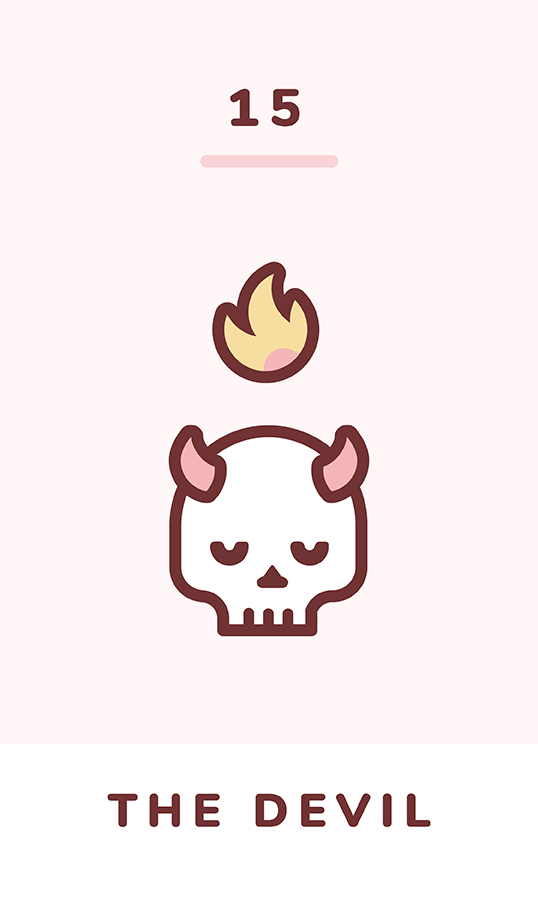
 

Naeily , Ami. “The Devil.” Cute Magick, 5 Apr. 2021, cutemagick.com/card-meaning/the-devil/.
I'm not going to go into the details, because as anyone who has ever been in this situation will tell you, after a while they don't matter (but I will tell you this: there's a fine line between a "healthy hobby" and an addiction). Hell is not just the substance, it's everything that goes with it: the lying, the rationalizations, the inability to plan for a future because there is no future past the next fix, and, as I said, that feeling of emptiness. Addiction is the fun house mirror version of "living in the present".

Someone else is on a path toward rehabilitation...perhaps. I am trying to plan for my future. Normal? No clue. But definitely happy.
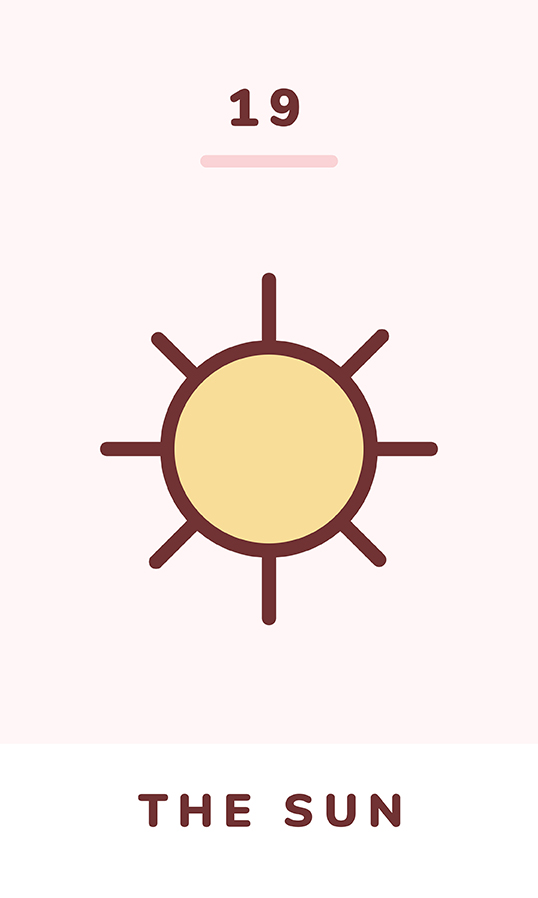
 
Naeily , Ami. “The Sun.” Cute Magick, 5 Apr. 2021, cutemagick.com/card-meaning/the-sun/.
Come at me 2021 and 2022; if I was fortunate enough to live through the last 15 months, I can get through anything.

Naeily , Ami. “The Fool.” Cute Magick, 5 Apr. 2021, cutemagick.com/card-meaning/the-fool/.
Deb in the City

Friday, March 15, 2013

Galileo's Muse by Mark Peterson

Mark Peterson's thesis: Galileo's scientific and more importantly mathematic genius was inspired not by contemporary Renaissance science but by classical and Renaissance arts.  At first, this seems like a fanciful proposition, but by the end of the book the reader will be convinced.

Although Peterson paints a detailed picture of Galileo's world and influences, several names come up repeatedly.  Perhaps the most important is Pythagoras (although it must be admitted that so little is definitively known about Pythagoras that we are probably giving deference more to the Pythagoreans than the man himself).  By the time Galileo was born, Pythagoras was like a mythic god whose teachings, always consciously mysterious, had been garbled to the point that most of what remained wasn't knowledge but lore.

Incredibly much of that lore wasn't just accepted but untested.  We see this particularly in music theory.  The ratio of two strings that were an octave apart was known to be 2:1 thanks to the Pythagoreans.  This was true, but for almost 2000 years it had been accepted that this meant simply doubling the tension on one of the strings.  Experiments performed by Galileo's father Vincenzo revealed that the tension needed to be increased by four- the square of two.  Similar experiments showed the same results for the accepted ratios for other intervals. Pythagoreans had realized centuries before that the relationship was exponential- geometric, if you will- but somehow that result had been lost and needed to be re-derived.


I thought this was the most fascinating chapter, and not only because I am not an expert in music theory.  The problem with tuning different instruments to each other that arose (in part) as a result of the misunderstood mathematics had been noticed, of course, by anyone who could hear.  However, because mathematics was so intertwined with philosophy, music teachers continued to insist that instruments be tuned by theory, even if the resulting sound was awful.

(As an aside, I note that the math around tuning seems dependent on a seven major note arrangement- CDEFGAB, for example.  I'd love to see how cultures that used a different system managed.)

Another name that comes up frequently: Dante, as in the author of The Divine Comedy.  Two short chapters will convince even the most skeptical that the poet not only knew classical mathematics but understood it well enough to be moved by it.  Peterson gives a close to literal translation of some of the last lines of the Paradiso that, on its face, seem fairly unintelligible ("I wanted to see how the human image/conforms itself to the circle, and finds its place there").  However, after Peterson explains some of Archimedes' (another important influence) work, the reader not only believes but understands that what Dante is talking about is the measurement of the circle.  Peterson's interpretation of Dante's description of Heaven and the physical and spiritual worlds is no less impressive; it is entirely possible that Dante anticipates the field of topology when he describes what we now call the hypersphere to describe the space of the philosophized universe.

Dante's universe, or the Hypersphere

It is easier, perhaps, to "see" the math in painting than poetry, and here we come to another important figure: Euclid.  His work on optics is an explicit influence on the perspective technique used by many painters.  While painting may seem (at first) to be a strange place to apply mathematics, Peterson talks about a number of painters fascinated with the subject, Piero della Francesca being among the most important but not, oddly, Leonardo da Vinci.

If painting is an unexpected place to find math, it is more surprising to find how much mathematics wasn't used in architecture (and engineering).  Brunelleschi's Santa Maria del Fiore in Florence, built a century before Galileo, is an example of a structure that pushes the physical limits of area versus weight.  This issue was instrumental in helping Galileo make a name for himself at the beginning of his career, then later threatened to undue him.  His jumping off point wasn't Santa Maria del Fiore but, rather, the dimensions of Dante's Hell.  (Although he took great pains to stress that this issue was theoretical and not physical, it is still a little horrifying to the modern mind that the subject was taken so seriously.)  He asserts as a young man in the Inferno Lectures that the roof of Hell, which is shaped like a dome, must be a certain dimension and is scalable.  It is only a few years later that he realizes scale has its limits; while the area will only be squared, the volume of the space will be cubed, or increased by another factor.  This probably contributed to the collapse of the cathedral at Beauvais.  According to Peterson, Galileo probably spent many years terrified that someone else would realize this too and spent a significant amount of time preparing his response.  (Surprisingly, the challenge never came.)

Santa Maria del Fiore

Peterson does more than just make his case for why a learned young man of the arts would see the beauty of  math and science more than someone trained in the science of the time.  (And it should be noted that while Galileo apparently spared little respect for Kepler and, shockingly, Copernicus, there were of course other scientists at the time who were also making amazing leaps in scientific understanding.)  He also helps the reader understand the intellectual history of the Western world and explain how mathematics and to some extent science came to be understood more as philosophical examinations of perfection and the role Galileo played in reviving them as concrete methods that could be used as tools.  Even something as basic as measurement was understood differently before Galileo's famous experiments.

It must be said that while much of the historical background is exciting, at a certain point the rigidity imposed by authorities- and not simply those of the Church- becomes stifling.  By the time Peterson starts mentioning the Arabs and Indians, they feel like a breath of fresh air.

Excellent book- recommended for the math and science enthusiast, as well as those who already the see the poetry contained in both.


"... the beauty of physics, the wonder of mathematics..."